• Partisans with a soundtrack: how Mexico gave voice to Yugoslavia

    When Yugoslavia sang in Spanish

    It sounds like a silly joke — what do Yugoslav partisans and Mexican revolutionaries have in common?

    Answer: heartbreak, resistance, and one hell of a soundtrack.

    In the decades after WWII, a surprising cultural romance bloomed between Yugoslavia and Mexico. No one planned it. It wasn’t political strategy. It just worked.

    Movies, murals, and mariachi ballads crossed oceans and language barriers—and somehow, they made perfect sense in a country rebuilding from war and trying to define itself outside of both American capitalism and Soviet control.

    This is the story of how Yugoslavia cried in Spanish, danced to mariachi, and found solidarity in the most unexpected places.


    Breakup of the Century: Or how did Tito told Stalin to get lost

    After World War II, Yugoslavia aligned with the Soviet Union. But Tito wasn’t interested in being anyone’s puppet, least of all Stalin’s. In 1948, they split. Yugoslavia got kicked out of the Cominform (the Soviet-led international communist organization), which essentially meant: no more Soviet support, and no Western alliance either. We went non-aligned.

    After that, Yugoslavia was politically isolated from both East and West. It didn’t want Soviet – style cultural propaganda, but it also rejected American capitalist imperialism and pop culture. So what was left?

    Enter: Mexico.


    Un día de vida: When a film hit harder than expected

    In the early 1950s, the Mexican film Un día de vida (One Day of Life) was shown in Yugoslavia. And to everyone’s surprise – it became a massive hit. It tells the story of a Mexican revolutionary soldier facing execution, and the final day he spends with his mother.

    This film hit Yugoslav audiences like a bomb. Why? Because Yugoslavia had just come out of its own brutal experience – World War II, Nazi occupation, and a bloody partisan resistance. The themes of sacrifice, revolution, and personal tragedy resonated deeply with people who had lost family, fought in resistance, and lived through this trauma.

    Audiences wept in cinemas. Traveled from city to city so they can re-watch it. Critics praised it. And most importantly – Yugoslavs saw themselves in the characters on screen.


    How revolutionary art crossed continents

    Around the same time, Mexican revolutionary art – especially the posters and murals from artists like Diego Rivera, José Clemente Orozco, and David Alfaro Siqueiros – began circulating in Yugoslavia. These artworks glorified the working class, the rural proletariat, revolutionaries, and anti-imperialist struggle. Their aesthetics matched the emotional and political atmosphere of post – war Yugoslavia.

    In a country recovering from war and building a new socialist identity, these bold, dramatic, emotionally charged Mexican visuals provided a model for expressing pride, pain, and defiance.

    Mexico, like Yugoslavia, had fought against dictatorship and foreign control. Their revolutions, though different in context, carried similar emotional and ideological weight.


    The birth of a Yugoslav-Mexican sound

    Once the movies and murals took root, the music followed.

    Yugoslav singers began covering Mexican songs—not as novelty acts, but as serious emotional performances. Translated lyrics. Full mariachi styling. Tearjerkers like La Paloma were sung in Serbo-Croatian—with full sincerity.

    Artists like Cune Gojković, Milić Ljubomir i Paloma, trio TiViDi, and Đani Maršan made sure this music wasn’t just heard—it was felt.

    By the ’60s and ’70s, Yumex was everywhere.

    Miroslav Mrđa feat Paloma – Bićeš moj

    Why did it worked?

    Yumex didn’t feel foreign. It felt personal. It told stories of resistance, love, death, and defiance – the kind of stories Yugoslavs knew intimately.

    It wasn’t about language. It was about recognition.


    Yumex hit Mainstream

    By the 1960s and 1970s, Yumex music was everywhere – on the radio, in live performances, and in state-sponsored events. These Mexican-inspired ballads fit perfectly into Yugoslavia’s vision of a non-aligned socialist society that was open to global cultural exchange – just not from imperialist sources.

    What made Yumex unique was that it didn’t come from political decree. It came from emotional demand. People wanted this music. It spoke to their experiences, even in a foreign language.

    Milić Ljubomir – Kome da poklonim ljubav

    By the late 1980s and early ’90s, as Yugoslavia began to fracture, Yumex faded from the mainstream. Pop culture shifted. Western music became more accessible. The emotional landscape changed.

    But it didn’t completely disappear.


    This shouldn’t make sense – but it does

    I didn’t grow up with Yumex. By the time I was born, Yugoslavia was already falling apart (shoutout to all of us born in the middle of a civil war).

    What I’ve always found fascinating – kind of weird, but also beautiful – is that whenever I meet someone from Latin America – whether it’s Mexico, Panama, Venezuela, Argentina, or anywhere else, there’s this deep connection. Like, we’ve been through the same shit, and we just get each other.

    The only other time I feel that kind of connection is when I meet people from the former Yugoslavia (or even just the Balkans). But with them, I share so much more – language, culture, childhood references, family. It makes sense. With Latin America, in theory, there shouldn’t be anything binding us that tightly – but it’s there.

    So even though I didn’t grow up with Yumex, I can absolutely see why people here connected with Mexico, its people, its stories, its music. Especially in the years after WWII.

    For them back then, I don’t think it was just about music. It was about finding connection in a time of isolation. About discovering a version of solidarity that wasn’t Western or Eastern, but something in between. Something that made sense to a country trying to define itself on its own terms.

    Because in the end, Yumex wasn’t just a genre. It was a mood, a memory, a bridge between worlds that weren’t supposed to touch – but did.

    Amazing movie on this specific topic in much more details, you can watch free on YT here:


    As for how I ended up learning Spanish thanks to ’90s telenovelas and music – and why my playlists still think I live in Mexico City – that’s a whole other story, but stay tuned.

  • Of Gods, Genders, and other untidy things

    I’m not a religious person. I had my episode with god when I was very young, it didn’t work out between us. I left and never looked back.

    That said, I live in a country where religion (not Islam) is deeply embedded in everyday life. Whether I like it or not, or believe in it or not, the idea of god is just… always around.

    For various reasons, though, I’ve been fascinated by Islam for most of my adult life. It started with the architecture – mosques, and the intricate, repetitive patterns used throughout Islamic design. I was drawn in by that, and also by the flow and sound of the Arabic language. Digging deeper into those two things pulled me into a whole web of other aspects of Islam. Not because I’m interested in believing in god or becoming religious, but because of everything else around it – the social, cultural, and sociological layers.

    Lately, I’ve been seeking out books that explore gender, especially around gender nonconformity, genderqueer, and non-binary identities. Somewhere in the mix of all that I just mentioned, I came across an amazing book called Hijab Butch Blues by Lamya H., and it kind of blew my mind.

    Before talking about the book itself, it’s important to note that Lamya H. is a queer, brown, nonbinary Muslim writing under a pseudonym due to the sensitive nature of their work.


    When the Divine gets personal About the Book

    The title of this book is a nod to Leslie Feinberg’s Stone Butch Blues, a classic queer text. In Hijab Butch Blues, Lamya writes about growing up as a queer person in a Muslim – majority country and later moving to the United States to study. The book traces their journey of self – discovery and spiritual growth, interweaving stories from the Quran with episodes from their own life.

    One of the most powerful and fascinating aspects of this book is how it connects the ancient with the present – linking the Quran, written in 610 CE, with the now. Each chapter is structured around a particular Quranic figure or story, and Lamya uses that story as a lens to explore something in their own life. It’s like they’re having a conversation with these ancient figures—pulling meaning and comfort from them, and sometimes pushing back too.


    The Story of Musa – or Leaving to become

    Lamya draws on the story of Musa, who fled from Pharaoh and found himself in exile, to reflect on their own journey of leaving their home country. Like Musa, they were running from something oppressive – not a literal Pharaoh, but a society where queerness was dangerous. The feeling of being cast out, but also finding yourself anew in that process, is a key emotional thread.

    “I wasn’t parting seas, but I was making space where there was none.”

    And boy, do I know about running away to become a self.


    The Amazing Story of Maryam – holy, misunderstood, and unapologetically alone

    One chapter that especially struck me was the story of Maryam. So much so that the first thing I did when I finished the book was go searching for that part in the Quran I own. (Which has to be the slowest I’ve ever read anything – it’s been almost a year, and I’m still near the beginning, so I haven’t gotten to the Surah Maryam yet.)

    In Surah Maryam (Chapter 19), Maryam is visited by the angel Jibreel (Gabriel) and told she will miraculously conceive a child — despite being unmarried and having had no physical relationship. Shocked and terrified, she withdraws from society:

    “So she conceived him, and she withdrew with him to a remote place.” (Qur'an 19:22)

    Her retreat is physical and emotional. She isolates herself from a world that wouldn’t understand her, a world that would likely judge or even harm her. She’s overwhelmed, grieving, and possibly on the edge of breaking:

    But here’s where the inner strength comes in. At her most desperate, she’s comforted — by divine presence, by nature (a palm tree offers her dates and water), and by the silent endurance she embodies. Eventually, she returns to her people with the child, silent, letting the child (Isa) speak for himself.

    Maryam’s story isn’t just about divine intervention; it’s about choosing solitude as survival, and finding clarity in being apart, even when the world misreads that as shame or retreat.

    Maryam’s story offers a blueprint for owning your distance — for making space not as a failure to belong, but as a radical act of self – preservation and transformation.

    There are many more stories like this throughout the book—stories that make you think, make you feel, and put you in a headspace you maybe haven’t visited before.


    Othered, but not alone

    You don’t need to be Muslim to relate to the feeling of being “othered,” of having to carve out space in a world that doesn’t see or accept you. Lamya uses Quranic figures to mirror moments of fear, isolation, transformation, and resilience.

    It made me reflect on questions like:

    • What stories shaped my understanding of myself growing up?
    • Was there a time I had to choose myself over familiarity? What parts of me only surfaced after I left?
    • Are there parts of my identity people say can’t coexist, but they do in me?

    Even if religious belief isn’t part of my life – or yours – the way Lamya reads sacred stories as layered, metaphorical, and emotionally rich reminded me how any text – myths, poems, childhood books, even movies, music – can become a mirror.

    It’s about seeing your reflection in places others don’t expect to find it – and maybe even in places you didn’t expect either.

    Reading this book as an outsider to Islam was still incredibly powerful. It invites a different kind of solidarity – one that’s not about shared beliefs, but shared struggles, and a shared hunger for freedom, truth, and love.

    It’s also a chance to practice deep listening: to witness someone’s story without needing to relate directly to every part, and still be transformed by it.

    If you’re looking for something that speaks to identity, resistance, gender, faith, and the right to exist on your own terms – Hijab Butch Blues is absolutely worth your time.

  • The history and mystery of Highgate Cemetery

    Imagine this: it’s February, a Monday morning in London, and it has been raining for days. The weather is absolute shit.

    A day before, I puked my life out in an incredibly beautiful and, important to mention, haunted old pub. Dragging myself out of bed felt like hell, but there was no way I was canceling my Highgate Cemetery tour. Even if they had to bury me there because I died on the tour, I was going.

    A cemetery that left me speechless

    Visiting this cemetery was at the top of my London to-do list. My friends had already done the tour the last time they were here, so I went alone. And even though they had told me a few stories about it, I was not prepared for how much it would blow my mind.

    So, picture this. It is still that miserable Monday morning, still raining, and I am standing in front of the cemetery entrance with my jaw on the floor because how the hell can a cemetery entrance look this pretty?


    A bit of history

    Highgate isn’t just any cemetery. It’s one of London’s Magnificent Seven, a group of grand, private cemeteries built in the 19th century when churchyards simply couldn’t keep up. Along with Highgate, the others include Brompton Cemetery, Nunhead Cemetery, Kensal Green Cemetery, West Norwood Cemetery, Abney Park Cemetery, and Tower Hamlets Cemetery.

    Before that, Londoners were buried inside churches if they were wealthy enough, or crammed into overcrowded graveyards if they weren’t. By the early 1800s, the city was running out of space, and the smell alone was enough to push Parliament into action. So, they built seven cemeteries outside the city, and Highgate became one of the most famous.

    Highgate Cemetery is divided into two sections:

    West Cemetery – The older, more atmospheric side with grand Victorian tombs, winding paths, and a gothic feel.

    East Cemetery – The more modern side, open for self-guided visits. It’s home to notable graves like Karl Marx, George Eliot, Roger Lloyd-Pack and many more.


    I mean, who doesn’t love a cemetery walk?

    It might sound weird to take a tour of a cemetery, but trust me, there is a good reason. The West side of the cemetery is only accessible via guided tour to protect its historic sites and delicate architecture.

    My tour guide was an older man named Nigel. After retiring and moving back to London, he started giving tours again. He had actually done the same tours back in the 90s, so he had a personal history with the cemetery and could tell us not only about its past but also about how much had changed over the years.

    One mind-blowing fact? All the tour guides do this voluntarily. No one gets paid to walk people around for an hour and a half, even in the freezing rain, through deep mud, carefully stepping between century-old gravestones. And mind you, many of them are older people who are retired.


    The people who keep it alive

    How weird is it to say you’re keeping alive a place where dead people rest? Hah, anyways.

    By the 1960s and 70s, Highgate Cemetery had fallen into complete ruin. Once a grand resting place, it had become overgrown, vandalized, and abandoned. Graves were collapsing, ivy covered everything, and the silence attracted grave robbers and occultists.

    Recognizing the need to preserve it, a group of dedicated volunteers formed The Friends of Highgate Cemetery Trust in 1975. They took on the big task of restoring the cemetery while keeping its romantic, gothic decay intact. They even bought the cemetery from its failing owners and have been maintaining it ever since.

    That is why you have guided tours. All the money goes directly into keeping the cemetery preserved.


    What I did not expect to find?

    Honestly, I was not expecting that much from the tour itself. I mostly just wanted to explore the cemetery and visit some special graves for myself, such as the ones from George Michael – whose voice and music were basically my childhood lullabies, Karl Marx – because, well, as a leftie, his grave was kind of a big deal and Roger Lloyd-Pack – who played Trotter in Only Fools and Horses, a British sitcom that was a huge part of my growing up and my first taste of British comedy, which I am a big fan of.

    Karl Marx – Highgate Cemetery 2025
    Roger Lloyd-Pack – Highgate Cemetery 2025

    So I had my own list of things I wanted to see. Everything else was just a bonus. But I had no idea how interesting this tour was actually going to be.


    The stories that stay with you

    Our guide took us to specific graves and told us the stories behind the people buried there. Who they were, what they loved, what they did, and how they ended up here.

    A story that caught my eye is about the Rossetti family drama.

    The Rossetti family tomb is famous not just for being the resting place of Elizabeth Siddall, wife of famous English painter and poet Dante Gabriel Rossetti, but also for what he did after her death.

    Overcome with grief, Rossetti buried a book of his unpublished poems he wrote to her, with her. Years later, regret (and financial struggles) led him to exhume the coffin and retrieve the book. Talk about goth.

    One fascinating detail about Karl Marx’s grave is that he isn’t alone – he’s surrounded by the graves of socialists, communists, and activists who dedicated their lives to fighting for a better world. These individuals came from all over, Britain, Iraq, Iran, South Africa… and their headstones stand as lasting tributes to their causes. Seeing this history etched in stone was really special for me.

    I walked a lot through both the West and East sides of the cemetery, reading the messages engraved in stone. And at the end of my very cold, very wet walk, I came across one gravestone that kinda broke me.

    It read:

    "To a great man, the essence of our lives, the polestar of my existence, the love of my life."

    Mansoor Hekmat 1951 – 2002 "To a great man, the essence of our lives, the polestar of my existence, the love of my life."

    A lot of little things on this trip made me think about the people I have lost. Walking through this cemetery, reading these tributes to love and loss, it felt like a button was pushed and I needed to let go.

    This was truly one of the most unforgettable travel experiences I’ve ever had. I could write pages about the cemetery, but if you ever get the chance to visit, I highly recommend seeing it for yourself.

    There’s so much more to discover, and I promise it’s an experience you won’t forget. It is worth every penny and every minute of your time.

    P.S. An interesting fact about Highgate Cemetery is that it’s home to a surprising amount of wildlife, including foxes. During our visit, just a few meters in front of us, we spotted a “local” pregnant fox wandering through the gravestones.

    More on the cemetery and some people and gravestones posted:

    Highgate Cemetery – website link

    Karl Marx – philosopher, economist, and political theorist
    Roger Lloyd-Pack – British actor
    Nazhad Ahmad Aziz Agha – deputy leader of the Parliament of Kurdistan
    Dr. Yusuf Mohamed Dadoo – South African Communist and an anti-apartheid activist
    Manuchehr Sabetian – Iranian consulting surgeon, humanist, and activist
    Mansoor Hekmat – Iranian Marxist, revolutionary and leader of the Worker-communist movement
    Dante Gabriel Rossetti – English poet, illustrator, painter, translator, and member of the Rossetti family

  • Don’t play cards with Satan: The art and madness of Daniel Johnston

    I have this friend who I always think about whenever I see a t-shirt with a design that’s unique, cool, or just plain weird. More often than not, I don’t actually send them the shirt I saw because if I sent every little thing that reminded me of the people I love and care about, they’d probably stop talking to me (as it’s a lot). But for whatever reason, I did send them this one.

    The design was this weird, frog-like creature, and it said “Hi, how are you?”. There was some other text too, but I didn’t really pay attention to it at first. What caught my eye was that it was embroidered, and I love anything with a textured design like embroidery, patches, buttons… anything that has that slightly 3D feel.

    Later, I took another look at the picture and finally noticed the rest of the text. I Googled it out of curiosity. And wow, was I right to.

    Turns out, the design was by an artist named Daniel Johnston – and if you’ve never heard of him, buckle up because his story is wild.


    The sound of imperfection

    Daniel Johnston was never famous in the way pop stars are famous, but his influence runs deep. His music, recorded on lo-fi cassette tapes in the ’80s, was raw, unpolished, and unfiltered. His songs weren’t technically perfect, his voice wavered, his melodies were simple, but that’s exactly what made them hit so hard.

    He started off recording songs in his parents’ basement with nothing but a cheap tape recorder and an unstoppable imagination. Albums like Hi, How Are You and Yip/Jump Music sound less like studio recordings and more like pages ripped straight from someone’s journal. They’re messy, heartbreaking, hopeful, and painfully real.

    At some point, Kurt Cobain discovered his music and started wearing a Hi, How Are You t-shirt (the same one I mentioned at the beginning), which instantly made Johnston a legend in underground music circles. Tons of artists have covered his songs over the years.

    But as much as people connected with his music, his struggles with mental illness were just as much a part of his story.


    A mind caught between genius and madness

    Daniel Johnston wasn’t just eccentric – he battled severe schizophrenia and bipolar disorder. His life swung between moments of brilliance and terrifying lows, between making beautiful music and being hospitalized for his mental health.

    His songs often feel like desperate letters to the universe – pleas for love, understanding, or just some kind of connection. Tracks like Some Things Last a Long Time and True Love Will Find You in the End aren’t just songs; they feel like someone pouring their heart out to you in the middle of the night. They’re not perfect, and that’s exactly why they’re perfect. They sound human.

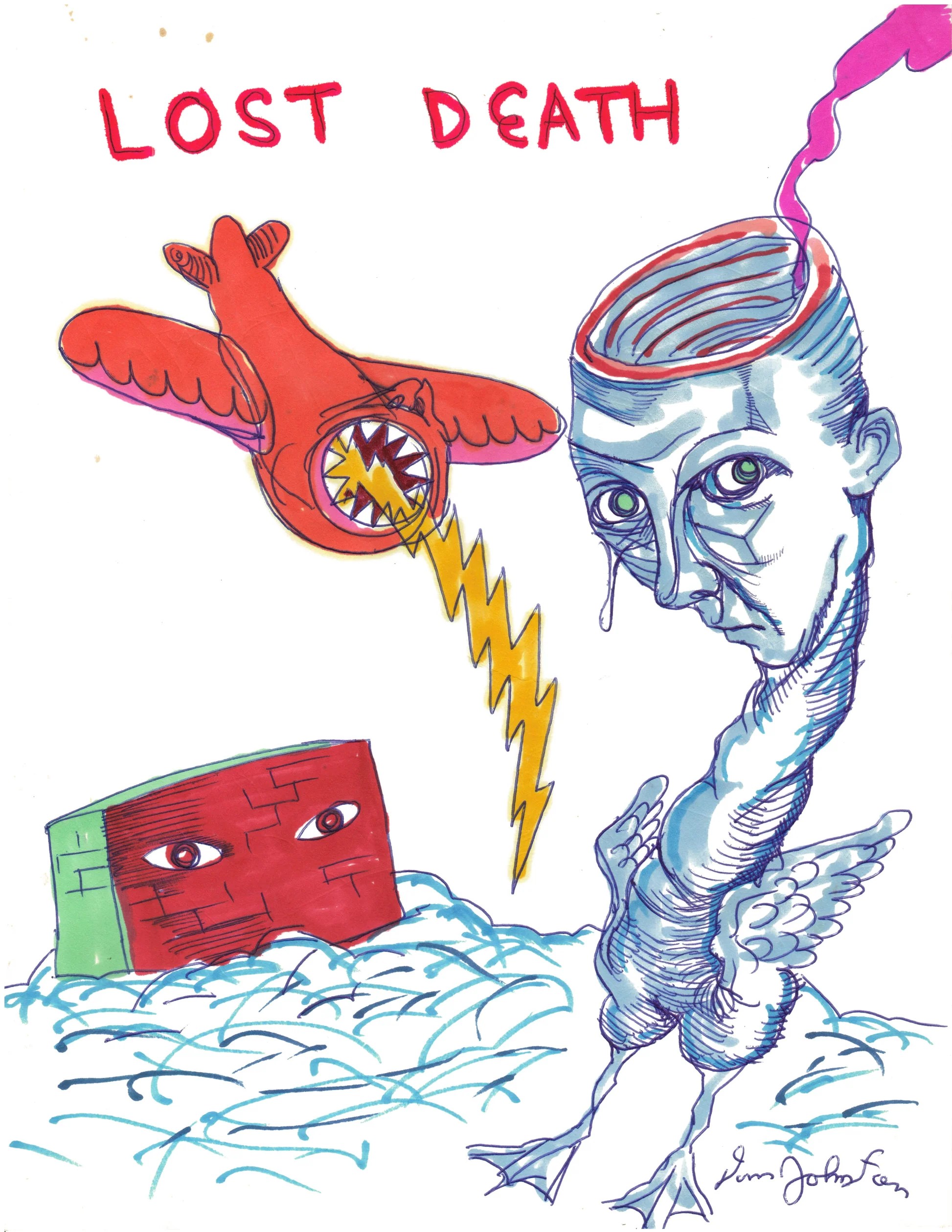
    His art was no different. He filled notebooks with sketches of frogs, eyeball monsters, and superheroes. His drawings often felt like glimpses into a world where good and evil were constantly at war, a battle that reflected his own inner struggles.

    And this brings me to one of the best ways to truly understand Daniel Johnston: the documentary “The Devil and Daniel Johnston.”


    “The Devil and Daniel Johnston”

    If you want to get a sense of who Daniel Johnston was, you need to watch The Devil and Daniel Johnston (2005). It’s an incredibly intimate, heartbreaking, and beautiful look into his life, his talent, his struggles, his highs, and his devastating lows.

    The film pieces together home videos, interviews, and recordings that show just how much of a creative force he was, but also how deeply his mental illness affected him.

    One of the most haunting moments is when it talks about the time he refused to take his medication, believing that the devil was trying to stop him from creating art. He even had an incident where he took the keys from a plane his father was flying and threw them out the window, causing them to crash-land. His father, thankfully, managed to land the plane safely, but it’s one of those stories that really highlights the chaos that mental illness brought into his life.

    The documentary doesn’t sugarcoat anything. It shows the ugly parts of his struggles, the heartbreaking parts, but also the sheer magic of his music and art. It’s the kind of film that sticks with you long after you’ve watched it.


    The Frog on the Wall

    In 1983, Daniel Johnston painted a wide-eyed frog on a record store wall in Austin, Texas, with the words “Hi, How Are You.” What seemed like a simple doodle became an icon.

    The frog, Jeremiah the Innocent, stares blankly, almost questioning. The phrase feels both friendly and haunting, a quiet check-in, a plea for connection.

    The mural nearly vanished in 2004, but Austin fought to keep it. Today, it stands as a symbol of outsider art, mental health awareness, and Johnston’s raw, unfiltered creativity. Even after his passing, his frog still asks, “Hi, how are you?”


    The art that lives on

    Daniel Johnston passed away in 2019, but his music and art still resonate. He left behind a body of work that proves you don’t have to be perfect to make something meaningful, you just have to be honest.

    Which is why I found it so important and powerful.

    In a world where everything feels overproduced and curated, Daniel Johnston’s raw, unfiltered creativity feels like a breath of fresh air. His music was for the misfits, the dreamers, the people who always felt like they were on the outside looking in. And maybe that’s why it endures, because deep down, don’t we all feel like that sometimes?

    So, if you haven’t already, put on a Daniel Johnston song. Close your eyes. Let yourself step into his world.

    It’s beautiful. It’s messy. It’s unforgettable.

    And maybe, just maybe, true love will find you in the end.


    Some of my favorite lyrics from Daniel’s songs:

    The Sun Shines Down on Me
    I’m walking down that empty road
    But it ain’t empty now
    Because I’m on it
    And I’m getting closer to a hope
    That I can carry and take home with me
    When the sun shines down on me
    I feel like I have to earn it
    When the sun shines down

    And some on his drawings:

    More info on music, art and Daniel in general can be found @

    Daniel’s Spotify
    Daniel’s Instagram
    Daniel’s website

  • Invisible imprints

    A research titled, “Parental olfactory experience influences behavior and neural structure in subsequent generations”, done in 2013 by Brian G. Dias and Kerry J. Ressler, investigates how different environmental factors, experiences or smells one generation is exposed to can have a long-lasting effect on the behaviors and neural development of its offspring.

    This is evidence of transgenerational epigenetic inheritance, meaning the idea that something your ancestor experienced leaves tiny “post-it notes” on the DNA. These notes change nothing in the genetic code itself; they are just instructions, and they are passed down to the offspring, influencing how the body or brain reacts to particular things.

    These researchers conducted a study on mice to see if a parent’s experiences with certain smells could affect their children. Here’s what they did:

    • They exposed adult mice to a specific scent and paired it with a mild shock, teaching the mice to associate that smell with danger.
    • Later, the researchers looked at the offspring of these mice, even though the young mice had never been exposed to that smell or experienced the shocks themselves.
    • The offspring were more sensitive to the same smell their parents had learned to associate with danger. Their brains also showed changes in the areas that process smells, making them more alert to it.
    • The researchers found evidence that this sensitivity was passed through changes in the sperm or eggs of the parent mice not through DNA itself, but through chemical markers (epigenetic changes) that influence how genes work.
    Abstract of this research states:
    
    "Using olfactory molecular specificity, we examined the inheritance of parental traumatic exposure, a phenomenon that has been frequently observed, but not understood. We subjected F0 mice to odor fear conditioning before conception and found that subsequently conceived F1 and F2 generations had an increased behavioral sensitivity to the F0-conditioned odor, but not to other odors. When an odor (acetophenone) that activates a known odorant receptor (Olfr151) was used to condition F0 mice, the behavioral sensitivity of the F1 and F2 generations to acetophenone was complemented by an enhanced neuroanatomical representation of the Olfr151 pathway. Bisulfite sequencing of sperm DNA from conditioned F0 males and F1 naive offspring revealed CpG hypomethylation in the Olfr151 gene. In addition, in vitro fertilization, F2 inheritance and cross-fostering revealed that these transgenerational effects are inherited via parental gametes. Our findings provide a framework for addressing how environmental information may be inherited transgenerationally at behavioral, neuroanatomical and epigenetic levels."

    I’m leaving this song here as well:

    Just some food for thought.

  • Gore and Glitter: Why “I Hate Fairyland” feels like freedom

    A Much-Needed Escape

    Between living in a country run by soulless, money-grabbing monsters with no sense of right or wrong, genocide in Palestine, bombs and tanks tearing through Syria and Lebanon, and juggling my own search for freedom while reading James Baldwin and bell hooks – oh, and work on top of all that – I desperately needed something to let my brain breathe, even just for a moment. That something came in the form of one of my all-time favorite comic books: I Hate Fairyland.

    The first time I stumbled upon this chaotic masterpiece was about five or six years ago. How I found it? Not a clue. But boy, am I glad I did. And now, hoping to escape reality for just a little while, I’m taking you with me and Gert on this bizarre adventure. Who knows? Maybe you’ll want to stick around in this weird world with us.


    What’s It About?

    I Hate Fairyland is a comic by Skottie Young, a guy who’s done some seriously cool stuff with Marvel – Spider-Man, Deadpool, Iron Man – and even won awards for his work on The Wonderful Wizard of Oz. If you’re a comic geek, you probably know about these. If not, trust me when I say this dude is good.

    The story? Oh, it flips every “magical fairy tale” right on its head.

    We follow Gertrude (Gert), a woman who, as a little girl, was whisked away to the whimsical land of Fairyland. Sounds fun, right? It was supposed to be. She had a simple quest: find her way home. Except… 30 years later, she’s still there. Trapped.

    The kicker? Gert still looks like a six-year-old, but mentally, she’s a bitter, foul-mouthed forty-something who despises everything about Fairyland. Armed with a giant battle-axe and exactly zero patience, Gert hacks, slashes, and swears her way through this pastel-colored nightmare, leaving destruction in her wake.

    Her BFF on this journey? Larry. He’s a snarky, chain-smoking fly who’s supposed to guide her, but honestly, he spends most of his time rolling his eyes and muttering sarcastic remarks at Gert’s… enthusiasm. Their dynamic? Chef’s kiss. Think chaos meets reluctant friendship, with Larry’s dry wit cutting through Gert’s unhinged rage.

    I love them so much.

    Why I Love it so much

    When I read I Hate Fairyland, I feel like Gert’s an old friend I haven’t seen in a while. She pulls me into her twisted little world, and for those moments, my own reality fades. That’s rare for me – there’s not a lot of art that can do that, over and over again.

    And Larry has to be one of my all-time favorite characters. Honestly, I probably feel more like him – sarcastic, frustrated, and just trying to get through the day without losing my mind. I’ve had a comic panel from Issue #10 – where Larry mutters “Really helps” – on my tattoo list for years. One day, I’ll get it.


    The real magic of Fairyland

    Beyond the gore, dark comedy, and candy-colored chaos, I Hate Fairyland resonates on a deeper level. It’s not just a story about a battle-axe-wielding kid in a magical world; it’s about refusing to conform.

    Fairyland is a prison disguised as a whimsical paradise, a place where everyone expects Gert to play along – smile, follow the quest, be happy. But Gert can’t fake it. She won’t. She knows it’s all bullshit, and she’d rather tear the place apart than pretend it’s something it’s not.

    If I’m being honest, that pressure to “play along” is something I’ve felt my whole life. Maybe that’s why I love Gert so much. She’s vile, violent, and sometimes a little crazy – but she’s a fighter. She fights through a world that doesn’t fit her, battling all the crap that’s thrown her way.

    There’s something cathartic about admitting, like Gert, that the world isn’t what it’s cracked up to be. Sometimes it feels fake, too cruel, or just not meant for us. And that’s okay. Like Gert with her battle-axe, we can carve our own path, make noise, and refuse to stay silent in a world that tries to shut us up.


    Sometimes, in hating the world around you, you end up finding who you really are.

    P.S. If you want to check out the comic, you can find it online here – Highly recommend diving into the chaos – it’s worth it.

  • Once an antifascist always an antifascist – the story of John Heartfield  

    An inexhaustible well of inspiration

    John Heartsfield was an absolute badass, if you ask me, and it’s a shame not many people know about him. He was a visual artist from Berlin, Germany, and the Nazis hated him as much as he hated them — which tells you a lot about him.

    He’s known as the father of photomontage, something he started experimenting with early in his career. Over time, photomontage became the centerpiece of his work. Let’s not forget, millennial’s and Gen Z that photoshop and computers were not the thing back at the beginning of the 20th century, so you can imagine how hard it would be to cut and glue everything by hand.

    I stumbled across John while researching anti-fascist artists and the history of Dadaism, something I’ve been fascinated by for a while. I found his art to be very bold and deep, and anyone who stood up to fascism (especially during Hitler’s reign) is already a hero in my book – add using art on top of that, they are a definite inspiration. He was a part of the Berlin Dada club and one of the people who helped organize the First International Dada Fair and also one of the first members of the German Communist Party.

    A bit about his life

    His father was a socialist playwright and his mother was a textile worker. Because of his father’s harsh critiques of the church and state in the late 1890s, the family had to flee Berlin to avoid his father’s imprisonment – they ended up in a secluded cottage in the Austrian woods, where they lived for a few years. One day his father disappeared and his mother suffered a mental breakdown in which she abandoned her children, leaving him and his three siblings alone in the woods. Adopted by an Austrian Catholic family, he never actually settled down in that surroundings. As a teenager, he returned to Germany to study art, eventually immersing himself in Berlin’s avant-garde scene.

    He was never fond of military authority and war and that prompted him to join the Berlin Dada Club in 1917. Dadaism had many forms around Europe, but in Germany, it was very political which gave him a good place for his activism and art against war. 

    Heartfiled broke through the graphic and printing techniques and was a part of revolutionary mass production that was then taking place. At that time he was one of the leading political artists in Germany. His political montages regularly appeared on the cover of Arbeiter-Illustrierte-Zeitung (a German illustrated magazine) from 1930 to 1938.

    In 1933 an SS broke into his apartment, taking most of his work with them. Luckily he was able to escape them, running to Czechoslovakia where he used to hide until 1938. When Germany occupied Czechoslovakia, he was forced to flee again—this time to England. Despite constantly being on the run (he was on the Gestapo’s top-five most-wanted list), he never stopped creating anti-fascist art.

    In 1951 he returned to East Berlin, but he wasn’t warmly received, even by the Communist Party. He worked on creating stage set designs for Bertolt Brecht and David Berg at the Berliner Ensemble and Deutsches Theater.

    He died in 1968 in East Berlin and was buried in the Dorotheenstadt Cemetery. After his widow, Gertrud Heartfield’s death, the East German Academy of the Arts took possession of all of Heartfield’s surviving works. When the West German Academy of Arts absorbed the East German Academy, the Heartfield Archive was transferred with it.

    John’s life is a testament to the idea that artists can fight just as hard as anyone else — both in and against war. 

    I find John to be one of the most inspirational artists I came across in my life. His art reflects everything he believed in and fought for, and no matter where he was in the world or what challenges he faced, he never stopped creating and resisting.

    Interesting fact, former Yugoslav music group Laibach has a number of references to Heartfield’s works, British hardcore punk band Discharge used his work “Peace and Fascism” for the cover artwork and, System of a Down used poster for the Communist Party of Germany (The Hand Has Five Fingers) as cover art on their 1998 self-titled debut album.

    And now finally, some of John’s work.

    BLOOD AND IRON – 1934
    THE HAND HAS FIVE FINGERS – 1928 (election poster with five fingers of the laboring hand and the number 5 which was the number of Communist Party’s electoral list)
    Whoever reads bourgeois newspapers becomes blind and deaf – Arbeiter-Illustrierte Zeitung (AIZ) 9. no. 6
    Concerning the German State Church – The Cross Wasn’t Heavy Enough Yet